
Buyer's guide
Heated Socks Buying Guide
How heated socks work, which battery system to choose, where the heat should sit, and how to size them.
Start here
Why heated socks?
Cold feet are the number one complaint we hear, and heated socks are the most direct fix there is. Thin heating panels sit at the toes — sometimes running back along the sole — and a small battery at the calf drives them. You feel it within a minute.
Socks range from about $30 to over $500, and the price gap comes down to three things: what powers them, how much of your foot the panel covers, and what the sock itself is made of. Get those three right and you'll stop thinking about your feet entirely.
- Heat lands where cold actually hits — the toes
- Works inside boots, ski boots, and work footwear
- A go-to for Raynaud's and poor circulation
- Rechargeable or disposable — your call
Power
Which battery system?
Heated socks run on five different systems. The real question isn't which is hottest — it's whether you want to charge a battery, swap one, or plug into a bike.
Disposable — swap and go
Three AA batteries per sock. Nothing to charge, nothing to plug in — when they run down you drop in fresh ones and keep going. At hunt camp, in a backcountry cabin, or anywhere without an outlet, you're never stranded.
The heat panel sits at the ball of the foot by the toes. One setting, one button, done.
- No charging — ever
- Perfect off-grid and at camp
- Cheapest way in
- Carry spares in a pocket
- About 3 hours per set
- Usually one heat setting
- Battery cost adds up
The everyday rechargeable
The standard rechargeable sock and our best seller — the one we recommend to most people. Batteries clip at the calf, charge overnight, and go back in the drawer. Three or four heat levels depending on the brand.
Run time lands around 8 hours on low and 4 on high, with some models pushing to 10. Panels run from the toes back along the sole, and you'll find these in both synthetic and moisture-wicking wool.
- Best all-round balance
- ~8 hrs low / ~4 hrs high
- Three to four heat levels
- Heats toes through the sole
- Synthetic or wool
- Widest brand and style choice
- Brand-specific battery
Standard USB — charges your phone too
Runs off an ordinary USB power bank rather than a proprietary pack — the same kind you already carry for your phone. And it works both ways: in a pinch, that battery will charge your phone back.
Premium moisture-wicking wool, and among the warmest socks on the market.
- Standard USB power bank
- Doubles as a phone charger
- Premium wool construction
- Excellent warmth
- Easy, cheap battery replacement
- Battery pack is a little bulkier
Maximum output, wool build
The hottest battery-powered socks we carry. Built for long sits in a cold blind, pre-dawn hikes, and genuinely brutal conditions — the kind of cold where lesser socks just don't cut through.
Premium wool traps the heat and wicks moisture. The trade-off is run time: on full blast, expect around 3 hours.
- The most heat on a battery
- Premium wool
- Best for extreme cold and long sits
- ~3 hrs on high heat
- Priciest option
Plugs into your motorcycle
Built for riders. A 12V sock wires into the bike's electrical system through a heat-troller, so it runs as long as the engine does — no battery to go flat two hours into a cold ride.
Typically paired with 12V heated insoles or a full heated gear setup. Off the bike, you're unplugged and unheated.
- Unlimited run time on the bike
- Strong, steady heat
- Pairs with other 12V gear
- Only works while plugged in
- Requires wiring / heat-troller
- Not for walking around
The short version: most people should get 3V — it's the standard rechargeable, our best seller, and it balances heat, run time, and price. Choose AA if you're away from power. Choose 5V if you want the USB battery that also charges your phone. Choose 7V for maximum heat on a long, cold sit. Choose 12V only if you ride. Run times vary with battery capacity and heat setting.
Coverage
Toe-only vs full-sole
Where the panel sits matters more than most people expect. Toe-only socks heat the spot that actually goes numb and sip less power, so they run longer. Full-sole socks spread warmth from toe to heel — more even, but the battery works harder.
If your complaint is numb toes, toe-focused is the smarter buy: you get longer run time exactly where you need it. If your whole foot goes cold, go full-sole.
Panel placement varies too — some sit on top of the foot by the toes, others on the ball of the foot underneath. Underfoot panels warm slightly faster; a few people can feel them inside a tight boot. Neither is wrong, but it's worth knowing before you buy.
Staff picks
What we actually wear
We wear this gear all winter. Here's what we'd buy at each price point — across every brand we carry, not just our own.
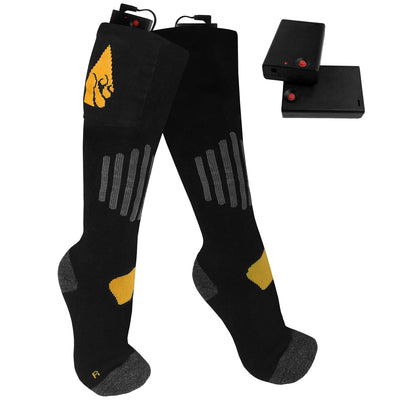
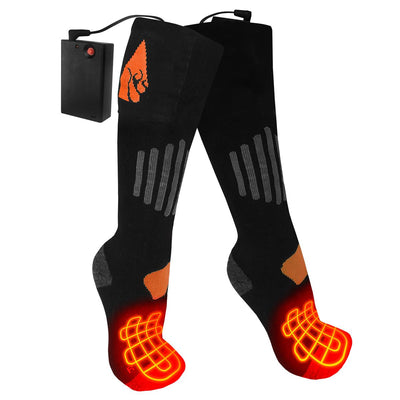
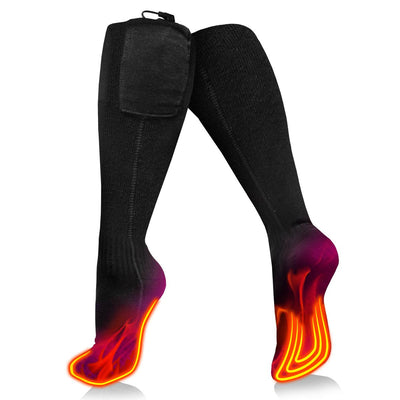
 ActionHeatActionHeat 5V Wool Battery Heated Socks$159.99
 Gobi HeatGobi Heat Roam Rechargeable Heated Socks with Remote Control$179.00
 GerbingGerbing 7V Ultimate Wool Heated Socks$189.99
This is the band most people should be shopping in. Real heat, a full day of run time, and wool that keeps working even after the battery quits. You do not need to spend more than this.
 SidasSidas Ski Heat LV Sock Set Powered by Therm-ic PowerSock S-Pack 1200$319.99
 HotronicHotronic XLP 2P Bluetooth Surround Comfort Heat Socks Set$417.00
 LenzLenz Heat Socks 6.1 Toe Cap Merino Compression with rcB 2000 Batteries$544.95
The most heat you can get on a battery, with the run time to match. If you sit still in real cold — a blind, a lift line, a job site — this is what we reach for.
Fit & care
Sizing, heat & washing
Heated socks want a snug fit. The panel has to sit against your foot to transfer heat — a loose sock bunches, shifts the panel off target, and heats air instead of you. Don't size up to make room.
On heat: start high for the first few minutes to take the edge off, then drop to low. You'll more than double your run time and stay comfortable all day. Running high the whole time is the single most common reason people think their socks 'don't last'.
- Snug fit — the panel must sit against your foot
- Warm up on high, then settle on low
- Always remove the batteries before washing
- Hand wash or gentle cycle in a mesh bag, then air dry
- Never put heated socks in the dryer
- Store lithium batteries at ~50% charge in the off-season
FAQ
Heated sock FAQ
How long do heated socks stay warm?
It depends on the system and the setting you use. Low heat typically runs 8–10 hours, medium around 5–8, and high often drops to 3–4. AA-powered socks give about 3 hours per set of batteries. Manufacturers usually quote the number for the lowest setting, so check the figure for the setting you'll actually use.
Should I size up for heated socks?
No. Heated socks need a snug fit so the heating panel sits against your foot. A loose sock bunches up, moves the panel off target, and wastes heat. Buy your normal size — but do check there's room in your boot, since heated socks are thicker than regular ones.
Can I wash heated socks?
Yes — remove the batteries first, every time. Hand wash in lukewarm water with mild detergent, or use a gentle machine cycle inside a mesh bag. Air dry completely. Never put heated socks in the dryer.
Will heated socks fit in my ski boots?
Ski boots need a thin-profile sock — look for the slimmer 3V-style socks rather than a thick wool build, and make sure there's clearance for the battery at the calf. Work boots are more forgiving but still need room for the battery pocket. Always test the fit before you head out.
Are heated socks good for Raynaud's or poor circulation?
They're one of the most common reasons people buy them. Heated socks warm the toes and soles directly, which helps prevent the vasospasms that cause numbness and pain. Start on the lowest setting and work up to the minimum temperature that keeps you comfortable. If you're diabetic or have reduced sensation in your feet, talk to your doctor first and monitor your skin.
Rechargeable or AA — which should I get?
Rechargeable (3V or 5V) makes sense for most people: more heat settings, longer run time, and no ongoing battery cost. Go AA if you'll be away from power — hunt camp, remote cabins, multi-day trips — where the ability to drop in fresh batteries beats everything else.
What's the difference between remote, app, and button control?
A wireless remote is the easiest in the field — change heat without reaching into your boot. A Bluetooth app gives you precise control and a battery readout from your phone, though it's fiddly with gloves on. A button on the battery is the most reliable but means reaching your calf. A touch button on the sock is quick but easy to bump by accident. If you'll be gloved up or in tall boots, pay for the remote or the app.
Do I need 12V socks for motorcycle riding?
Only if you want unlimited run time. 12V socks plug into the bike through a heat-troller and run as long as the engine does — ideal for long cold rides where a battery would die halfway. The trade-off is you're tethered: off the bike, they don't heat. Plenty of riders use rechargeable 3V or 7V socks instead and accept the run-time limit for the freedom to walk around.
Can I feel the heating elements inside the sock?
Usually not, but it varies. Panels on top of the foot are essentially undetectable. Underfoot panels warm slightly faster and most people never notice them — though if you're sensitive to anything in your boot, you may feel them on the sole. If that's a concern, choose a sock with the panel on top of the foot.
Ready to shop heated socks?
Browse every heated sock we carry, or reach out and we'll help you pick the right pair.
Shop heated socks

